
Should You Overpay Your Mortgage in 2026?
Following my recent feature on Sky News regarding the pros and cons of overpaying your mortgage, I’ve had a surge of questions about how to apply this to personal finances in 2026.
The concept is simple: if you never “see” the money because it’s redirected at the source, you don’t miss it. But where should that money go? If you have a surplus of £1,000, you generally have three main options. Let’s look at the impact of that £1,000 over a 10-year period.

1. Paying Off Your Mortgage (The Defensive Play)
With mortgage rates sitting around 5%, overpaying is a “risk-free” return. You are effectively “earning” the interest you avoid paying.
- The Impact: Over 10 years, a £1,000 overpayment saves you approximately £628 in interest.
- Total Benefit: Your net position improves by £1,628.
- The Verdict: Great for peace of mind, but is it the most efficient?
Benefits:
 Completely guaranteed — no market risk
- Tax-free — you don’t pay tax on interest you never owe
- Peace of mind — reducing debt has real emotional value
- Shortens your term, so you’re debt-free sooner
2. The Pension Power-Up (High-Rate Taxpayer)
For high-rate taxpayers, the pension is often the “maths winner” due to 40% tax relief. We’ll assume 7% returns with 1% fees (6% net).
- The Math: Because of tax relief, your £1,000 “take-home” cost puts a much larger gross sum to work immediately.
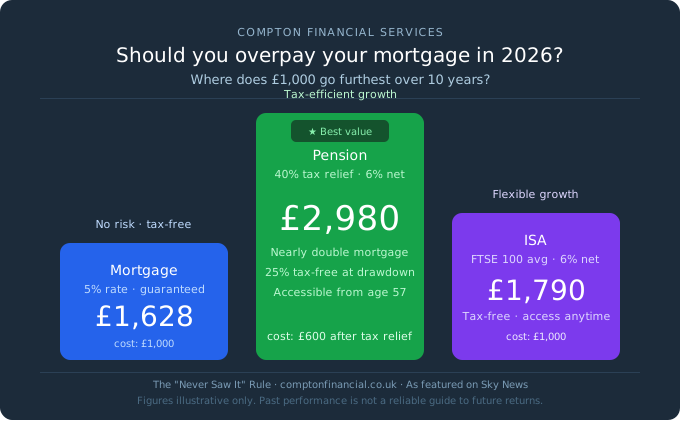
- The Impact: After 10 years of compounding at 6% net, that investment grows to approximately £2,980.
- Total Benefit: Nearly double the mortgage benefit.
Benefits:
- Instant 40% uplift from tax relief
- Tax-efficient growth inside the pension wrapper
- 25% tax-free lump sum available at drawdown
3. Stocks & Shares ISA (The Flexible Growth)
If you want growth but need accessibility, the ISA is the tool. We’ll use the FTSE 100 average of 7% returns with 1% fees (6% net).
- The Impact: Your £1,000 is invested from post-tax income. Over 10 years, it grows to approximately £1,790.
- Total Benefit: £1,790 entirely tax-free.
- The Verdict: Better growth than a mortgage overpayment, with the benefit of accessibility.
Benefits:
- Tax-free growth and withdrawals
- Fully accessible — no age restrictions
- Up to £20,000 per year allowance
Putting It All Together: The 10-Year Comparison
| Option | Actual Cost | 10-Year Value | Risk |
|---|---|---|---|
| Mortgage (5%) | £1,000 | £1,628 | Guaranteed |
| Pension (40% Tax) | £600 | ~£2,980 | Market Risk |
| ISA (6% Net) | £1,000 | ~£1,790 | Market Risk |
Figures are illustrative. Past performance is not a reliable guide to future returns. Tax treatment depends on individual circumstances.
The 2026 Verdict: Should you overpay your mortgage?
The numbers tell a clear story: while overpaying a 5% mortgage is a solid, defensive choice, the financial impact of the alternatives is hard to ignore. If you’re a higher-rate taxpayer, the pension is in a different league. By utilizing tax relief, you are potentially walking away with nearly £3,000 a decade later from a £600 net cost.
The ISA sits comfortably in the middle, offering flexibility and growth. It’s a powerful complement to your retirement planning, providing accessibility if your plans change.
This is where the “Never Saw It” rule comes into its own. Rather than spending surplus money without thinking, automating it—perhaps even splitting it across a pension and an ISA—means you’re quietly building wealth in the background. You’re essentially turning £1,000 of “lost” spending money into nearly £3,000 of future wealth.
Ultimately, deciding should you overpay your mortgage in 2026 comes down to balancing guaranteed debt reduction against the higher growth potential of a pension.
Have a question about which option suits your situation? Drop it in the comments below, or get in touch with us directly for a no-fee conversation.
Martin Compton is the founder of Compton Financial Services, a mortgage broker and chartered financial adviser based in the UK. With offices in
Farnham (Surrey) and Wimbledon (SW London).
As featured in: Sky News
Disclaimer: This article is intended for information purposes only and does not constitute personal financial advice. Your home may be repossessed if you do not keep up repayments on your mortgage. The value of investments can fall as well as rise.