

Martin Rayner is regularly asked by national, financial and property media for his view on mortgages, the housing market, buy-to-let, pensions and tax. Below is the coverage where his commentary has appeared, with a summary of what he said in each article.

Experts advise on giving inheritance early with April 2027 rule change
“The problem with traditional inheritance planning is that the money often arrives when it is least needed. We typically see people passing on wealth in their 70s or 80s, meaning their children are already in their 50s and may be financially established. That is why planning should be genuinely intergenerational, including grandchildren.”
“A grandparent can fund a bare trust for a grandchild and, if they have little or no other income, the child could potentially receive up to £18,570 of savings income tax-free each year, using their £12,570 Personal Allowance, £5,000 starting savings rate and £1,000 Personal Savings Allowance, plus their £3,000 CGT exemption.”
“We often see this used for education or university costs rather than building a large house deposit. The important catch is that the money belongs to the child and they can take control at 18, which understandably may make grandparents wary of building up too large a sum.”
— Martin Rayner, Chartered Financial Adviser and Mortgage Broker, Compton Financial Services
Insight: Martin argues that wealth often passes down a generation too late to make a difference, and sets out how a bare trust for a grandchild can put the child’s own tax allowances to work, with the trade-off that control passes to them at 18.
Topic: Inheritance planning, gifting and bare trusts
Read the articleHousebuilders ‘real winners’ of Andy Burnham’s Your First Home scheme
“The market has already spotted one likely beneficiary from Your First Home – the housebuilders. This scheme should bring more potential buyers into the new-build market. That means more demand, potentially more sales and greater confidence for developers. First-time buyers can benefit too. For someone earning enough to support the mortgage but struggling to save a large deposit while paying rent, this could genuinely get them onto the housing ladder years earlier.”
“The concern is what happens to prices. If you increase buyers’ purchasing power but do not increase the supply of homes quickly enough, some of that benefit risks feeding into higher new-build prices rather than better affordability.”
“So this could be good news for first-time buyers, but the early reaction in housebuilder shares is a useful reminder: when government supports the demand side of housing, buyers are not necessarily the only ones who benefit.”
— Martin Rayner, Chartered Financial Adviser and Mortgage Broker, Compton Financial Services
Insight: Martin welcomes the help for renters who can afford repayments but not a deposit, while warning that boosting demand without new supply can push up new-build prices and hand much of the benefit to developers.
Topic: First-time buyers, new-build homes and government housing schemes
Read the article
The ‘real winners’ and the catch: What you need to know about revived Help to Buy scheme
“The market has already spotted one likely beneficiary from Your First Home – the housebuilders. This scheme should bring more potential buyers into the new-build market.”
— Martin Rayner, Chartered Financial Adviser and Mortgage Broker, Compton Financial Services
Insight: Sky News uses Martin’s comment to explain why housebuilder shares rose on news of the revived scheme, and why buyers should look closely at who really gains.
Topic: Help to Buy, Your First Home and the new-build market
Read the article
‘Surprisingly little difference’: advisers react to triple lock reform
“We generally plan retirement income around maintaining spending power, so inflation matters far more than what average wages happen to be doing.”
“The state pension is one part of the picture alongside personal pensions, investments and other assets.”
— Martin Rayner, Chartered Financial Adviser and Mortgage Broker, Compton Financial Services
Insight: Martin explains that retirement plans are built around keeping pace with inflation, so changes to the triple lock’s earnings link matter less than headlines suggest, with the state pension only one part of a wider income plan.
Topic: State pension, triple lock and retirement income planning
Read the article
Advisers’ Budget 2026 wish lists – ‘this is a scary one’
“Reverse bringing pensions into estates for inheritance tax and unfreeze IHT thresholds as fiscal drag is pulling more ordinary families into the tax. Then leave pensions alone.”
“Also give business owners stability on CGT and Business Asset Disposal Relief. Selling a business can represent 30 years’ work; they need a runway, not a Budget cliff edge.”
“The biggest improvement would be boring but valuable – fewer surprises, longer-term planning and rules that survive more than one Budget.”
— Martin Rayner, Chartered Financial Adviser and Mortgage Broker, Compton Financial Services
Insight: Martin’s Budget wish list centres on stability: reversing the move of pensions into estates for inheritance tax, unfreezing thresholds, and giving business owners a predictable runway on CGT and Business Asset Disposal Relief.
Topic: Budget 2026, inheritance tax, pensions and business owners
Read the article
HMRC new rules now in force ‘affecting 700,000 workers’
“Same person, same client, same job and often the same day rate, but suddenly they look completely different to a mortgage lender. Someone paid through an umbrella in March might now be on agency payroll or working through a limited company.”
“Economically very little may have changed, but mortgage underwriting is built around neat employment boxes. The good news is that the clock does not always restart. Some lenders will look through the new structure and use a contractor’s track record, current contract and day rate.”
“Others may want fresh payslips, accounts or more history in the new setup. That difference matters.”
“A perfectly good borrower can suddenly find their lender choice narrowed, leaving them reliant on a product transfer or delaying a purchase. The mortgage industry needs to recognise continuity of work, not just continuity of paperwork.”
— Martin Rayner, Chartered Financial Adviser and Mortgage Broker, Compton Financial Services
Insight: Martin explains how the April umbrella company changes can make an unchanged contractor look like a new applicant to lenders, and why choosing a lender that assesses day rate and track record can avoid a restart of the income history clock.
Topic: Contractor mortgages, umbrella company rules and lender criteria
Read the articleBrits warned of 1 ‘relatively minor mistake’ causing expensive mortgage ‘nightmare’
“The most common example we see is parking fines and motoring penalties being sent to an old address after someone has moved home. The correspondence is missed, the debt escalates and what started as a relatively minor charge can ultimately result in a CCJ.”
“In many cases, the first time the individual becomes aware of it is when they apply for a mortgage. The irony is that the original debt is often tiny compared with the consequences.”
“A small parking fine can restrict mortgage options or even prevent someone from obtaining a mortgage. A £60 fine can end up costing thousands in extra interest payments on a mortgage. The simplest advice is to update both your driving licence and vehicle logbook (V5C) whenever you move house.”
— Martin Rayner, Chartered Financial Adviser and Mortgage Broker, Compton Financial Services
Insight: Martin highlights how an unpaid fine sent to an old address can escalate into a County Court Judgment that limits mortgage choice, and gives the simple fix of updating your driving licence and V5C when you move.
Topic: CCJs, credit files and mortgage eligibility
Read the articleUnpaid parking fines ‘can mean losing home’ as record numbers issued
“The most common example we see is parking fines and motoring penalties being sent to an old address after someone has moved home. The correspondence is missed, the debt escalates and what started as a relatively minor charge can ultimately result in a CCJ.”
“A small parking fine can restrict mortgage options or even prevent someone from obtaining a mortgage. A £60 fine can end up costing thousands in extra interest payments on a mortgage. The simplest advice is to update both your driving licence and vehicle logbook (V5C) whenever you move house.”
— Martin Rayner, Chartered Financial Adviser and Mortgage Broker, Compton Financial Services
Insight: With parking fines at record levels, the Mirror carries Martin’s warning that a missed letter can become a CCJ that costs far more in mortgage interest than the original fine.
Topic: Parking fines, CCJs and mortgage applications
Read the articleSantander and Octopus Energy new £29,000 update issued
“If the purchase price is significantly higher, the savings on energy bills could be offset by the extra mortgage and interest over time.”
“The key is to compare the total cost of ownership against other properties, rather than looking at energy bills in isolation.”
— Martin Rayner, Chartered Financial Adviser and Mortgage Broker, Compton Financial Services
Insight: Martin urges buyers looking at energy-efficient homes to weigh any price premium, and the extra borrowing it needs, against the lower bills, judging the total cost of ownership rather than energy savings alone.
Topic: Green mortgages, energy-efficient homes and total cost of ownership
Read the articleMortgage method could ‘shave years off’ with ‘small payments’
“The bigger question, though, is whether overpaying is the best use of your spare money. I do not automatically recommend it.”
“We compare it against pensions and other investments first. Paying down a 4% mortgage gives you a guaranteed 4% return, but many higher earners can achieve a much better outcome through pension contributions. A higher-rate taxpayer can receive 66% effective tax relief, while someone caught in the £100,000 to £125,140 personal allowance trap can receive effective relief of up to 150%.”
“Put simply, £40 of take-home pay can become £100 in a pension. Mortgage overpayments are a fantastic tool in the right circumstances, but they should be weighed against pensions, ISAs and other financial priorities rather than being treated as the default home for every spare pound.”
— Martin Rayner, Chartered Financial Adviser and Mortgage Broker, Compton Financial Services
Insight: Martin compares the guaranteed 4% return from overpaying a 4% mortgage with effective pension tax relief of 66% for higher-rate taxpayers and up to 150% in the personal allowance trap, and explains why overpaying should not be the automatic choice.
Topic: Mortgage overpayments, pension tax relief and financial priorities
Read the article
Should you buy a flat as the cost to upgrade to a house hits a 30-year high?
“Most people do not buy a flat because they prefer it to a house.”
“They buy one because it is more affordable. For first-time buyers especially, the choice is often a flat or nothing at all.”
“Purpose-built flats are usually the safer option. They were designed as flats from day one, tend to have better soundproofing and are often professionally managed.”
“The downside is they can feel a bit soulless and service charges can be higher.”
“Converted houses offer more character, but they can come with surprises.”
“A well-run block will almost always be worth more than a neglected one, regardless of [its] type.”
— Martin Rayner, Chartered Financial Adviser and Mortgage Broker, Compton Financial Services
Insight: With the average house now costing 1.7 times the price of a typical flat, Martin explains why purpose-built flats are usually the safer buy for first-time buyers, what to watch for with conversions, and why good block management protects a flat’s value.
Topic: First-time buyers, flats versus houses and leasehold management
Read the articleWhat could Andy Burnham as prime minister mean for your money?
“The council tax debate is particularly worrying. Council tax was designed to fund local services, with bands based on relative property values within a local area.”
“It was never intended to mean that two homes worth the same amount in different parts of the country should automatically pay the same tax.”
— Martin Rayner, Chartered Financial Adviser and Mortgage Broker, Compton Financial Services
Insight: Martin cautions against council tax reform that ignores its local purpose, explaining that bands were built on relative values within an area, not national comparisons between similarly priced homes.
Topic: Council tax reform, property taxes and household finances
Read the article
Burnham in. Reeves and Starmer out. What does that mean for UK property?
“The smartest move right now is to secure a fixed-rate deal. It’s one of the few real win-win opportunities – it protects you from rising rates while still allowing you to benefit if rates fall.”
— Martin Rayner, Chartered Financial Adviser and Mortgage Broker, Compton Financial Services
Insight: Writing for brokers during the leadership change, Mortgage Introducer quotes Martin’s practical message for clients: lock in a rate now, protected if rates rise and free to switch if they fall.
Topic: Political uncertainty, swap rates and remortgage strategy
Read the article
New ‘unsustainable’ alert for people on PIP from DWP after update this week
“PIP is essential for many people, but the cost is rising year after year and there is little sign of that trend slowing. At the same time, the UK continues to spend more than it brings in, with national debt still climbing. If a client came to me with spending that consistently exceeded their income and debt that kept rising, I would tell them the situation was unsustainable.”
“The Government should be judged by the same standard. For those genuinely in need, support should absolutely be there. The real debate is where the line is drawn, because every extra pound spent comes with a trade-off. The choices are always the same: higher taxes, more borrowing or less spending elsewhere.”
“The longer this is left unaddressed, the harder it becomes to fix. Rising debt means rising interest costs, which leaves less money available for everything else. Someone always pays the bill, whether through higher taxes, reduced public services or the burden being passed to future generations.”
— Martin Rayner, Chartered Financial Adviser and Mortgage Broker, Compton Financial Services
Insight: Martin applies the test he would use with a client’s own budget to public finances: support for those in genuine need should stay, but spending that keeps exceeding income has to be paid for through tax, borrowing or cuts elsewhere.
Topic: Public finances, welfare spending and national debt
Read the article
What Burnham as PM means for your mortgage
“The smartest move is to secure a fixed-rate deal now. It is one of the few real win-win opportunities available to borrowers because it protects you from rising rates while still allowing you to benefit if rates fall.”
“Most lenders let you lock in a rate up to six months before your current mortgage ends, while existing lenders will often allow a new deal to be reserved around three months before expiry.”
“If rates rise, you are protected. If rates fall, many lenders will allow you to switch to the lower rate before completion. That puts you in a far stronger position than waiting until your fixed term ends and simply taking whatever rates are available at the time.”
— Martin Rayner, Chartered Financial Adviser and Mortgage Broker, Compton Financial Services
Insight: Martin explains how borrowers coming off a fixed rate can reserve a new deal up to six months ahead with a new lender, or around three months with their existing one, and still switch if rates fall before completion.
Topic: Remortgaging, rate reservations and fixed-rate timing
Read the articleEstate planning and retirement top clients’ priorities
“Inheritance tax is often described as a tax on the unprepared, and we are definitely seeing a growing focus on estate planning and intergenerational wealth transfers.”
“We are also having far more conversations about retirement lifestyle planning. Clients are increasingly asking not just whether they can afford to retire, but how early they can retire and what level of income they can realistically sustain.”
“The focus has shifted from simply building wealth to understanding how and when it can be used.”
— Martin Rayner, Chartered Financial Adviser and Mortgage Broker, Compton Financial Services
Insight: Martin describes a shift in client conversations away from simply building wealth towards when and how to use it, with more focus on estate planning and on how early retirement can realistically start.
Topic: Estate planning, retirement planning and intergenerational wealth
Read the articleMost investors ‘paying premium fees for poor returns’ says adviser
“The data on how active funds perform relative to trackers is astonishing and is something more regular investors need to be aware of. For example, I often draw people’s attention to research from Standard & Poor’s Indices Versus Active (SPIVA), which shows that, in Europe, 97% of active funds have underperformed the S&P Europe 350 index over a 10-year period.”
“So many investors are paying higher fees for active funds despite the evidence showing that a large majority underperform comparable tracker funds over the long term. In short, many people are paying through the nose for underperformance.”
“This is not about ruling active funds out altogether, but rather using them strategically in a portfolio, for example to give you exposure to a specialist sector or emerging market. But for many investors, having low-cost tracker funds doing the heavy lifting in their portfolio will often be the starting point.”
— Martin Rayner, Chartered Financial Adviser and Mortgage Broker, Compton Financial Services
Insight: Citing SPIVA research showing 97% of European active funds lagged their index over 10 years, Martin makes the case for low-cost trackers at the core of most portfolios, with active funds used selectively.
Topic: Investment fees, active versus passive funds and portfolio construction
Read the articleNew warning to home sellers over ‘fantasy number’ with problem worse in one UK area
“Estate agents are competing for fewer instructions and sellers naturally gravitate towards the highest figure. There is a long-standing industry perception that some agents win business with optimistic valuations before expectations are brought back down to reality.”
“I recently spoke to a client selling a property worth around £1.6m-£1.7m. One agent suggested £2m based on a supposedly similar sale. When checked, the property was not genuinely comparable.”
“He wisely obtained three valuations before deciding on a realistic price. Overvaluations waste everyone’s time. Sellers miss opportunities, buyers become sceptical and transactions can fall apart when surveyors arrive at a very different figure.”
— Martin Rayner, Chartered Financial Adviser and Mortgage Broker, Compton Financial Services
Insight: Drawing on a recent client case, Martin explains why overvaluations rise in a slower market and why sellers should get three valuations, since an inflated price can unravel when the buyer’s surveyor values the property.
Topic: Property valuations, selling a home and down-valuations
Read the articleNew ‘fantasy number’ warning to anyone selling their home
“Estate agents are competing for fewer instructions and sellers naturally gravitate towards the highest figure. There is a long-standing industry perception that some agents win business with optimistic valuations before expectations are brought back down to reality.”
— Martin Rayner, Chartered Financial Adviser and Mortgage Broker, Compton Financial Services
Insight: The Mirror carries Martin’s explanation of why optimistic agent valuations become more common when the market slows, and why sellers should treat the highest figure with caution.
Topic: Estate agent valuations and pricing a property to sell
Read the articleFCA guidance suggests fake reviews could breach consumer duty
“It is not unheard of for firms to suddenly appear with vague, generic five-star reviews that tell consumers very little about the service.”
“Once that starts, other firms feel pressure to compete on the same basis and trust in the whole review system is lost.”
“If fake or manipulated reviews influence a customer’s choice of mortgage broker or financial adviser, that should clearly create a consumer duty risk.”
— Martin Rayner, Chartered Financial Adviser and Mortgage Broker, Compton Financial Services
Insight: Martin welcomes the FCA’s guidance as long overdue, arguing that vague or manipulated reviews undermine trust across the sector and that steering consumers with them should be treated as a Consumer Duty issue.
Topic: Online reviews, Consumer Duty and trust in financial advice
Read the article
Experts warn that it is ‘no surprise’ a third of people do not believe a university degree is worth it – as inquiry launched into student debt
“It is no surprise that more people are questioning whether university is worth the cost. Yesterday we advised two first-time buyers. One had an £81,000 student loan and the other £40,000. These loans will never be repaid. That helps no-one. The problem is that we have spent years treating university as the default option.”
“For some careers a degree is absolutely worth it and remains the best route into a well-paid profession. For others, the financial return is far less clear and alternative routes such as apprenticeships may make more sense. Young people need honest information before taking on decades of repayments.”
“An inquiry is needed because we have graduate unemployment alongside major shortages of skilled tradespeople. We are encouraging more people into higher education while employers struggle to recruit in sectors where demand is highest. That raises important questions about whether the system is delivering value for students, taxpayers and the wider economy.”
— Martin Rayner, Chartered Financial Adviser and Mortgage Broker, Compton Financial Services
Insight: Using two recent first-time buyer cases, Martin questions university as the default route and supports the inquiry into whether student debt delivers value for graduates and taxpayers.
Topic: Student loans, first-time buyers and the value of a degree
Read the article
Why it pays to access financial advice – and why more families can now do so low-cost
“For regular households, financial advice can absolutely be worth it because the biggest benefits are often about avoiding expensive mistakes and building long-term financial security. A good adviser can help families budget more effectively, use tax allowances properly, put the right protection in place, invest consistently and create a realistic financial plan around goals like buying a home, retiring comfortably or supporting children financially.”
“Historically, cost has been a barrier for some households, but AI and better technology are helping make advice more affordable and accessible by reducing administration and improving efficiency, allowing firms to support a much wider range of families.”
— Martin Rayner, Chartered Financial Adviser and Mortgage Broker, Compton Financial Services
Insight: Martin sets out where advice adds most value for everyday households, from tax allowances to protection and long-term goals, and how technology is lowering the cost so more families can access it.
Topic: Value of financial advice and access to advice
Read the articleHow tax and targeted support will help boost annuity sales to Britons
“Much of the increased demand would depend on education around how annuities can be used in retirement planning.”
“Once clients understand the range of uses annuities can have, rather than seeing them as outdated products, I think we are likely to see a significant increase in demand over the coming years.”
“It is important to dispel the myth that annuities are the ‘old way’ of retirement planning. They are simply another tool in the retirement toolkit and, for the right client, can be extremely valuable.”
“Fixed-term annuities can help bridge an income gap, for example between retirement and state pension age, while preserving future flexibility.”
— Martin Rayner, Chartered Financial Adviser and Mortgage Broker, Compton Financial Services
Insight: Martin challenges the idea that annuities are outdated and gives the example of a fixed-term annuity bridging the gap between retirement and state pension age while keeping later options open.
Topic: Annuities and retirement income planning
Read the articleHomebuyers told ‘perfect time’ as ‘dynamic has changed’ after update this week
“The housing market has stalled because buyers are nervous. Ongoing conflict in Iran, volatility in financial markets, political uncertainty around the Labour government and speculation over future leadership are all pushing up wholesale swap rates, which then feeds directly into higher mortgage pricing and weaker buyer confidence.”
“Constant headlines about mortgage rate increases only add to the caution, even when some of the reporting exaggerates the reality. Affordability is already stretched, so many buyers are choosing to wait rather than commit during a period of uncertainty.”
“That inevitably slows price growth. At the same time, landlords continue to exit the market due to higher taxes, regulation and borrowing costs.”
“Fewer rental properties means less supply, so rising rents are almost inevitable. The danger is ending up with the worst of both worlds: a stagnant housing market for buyers and an increasingly unaffordable rental market for tenants.”
— Martin Rayner, Chartered Financial Adviser and Mortgage Broker, Compton Financial Services
Insight: Martin links the stalled housing market to nervous buyers and rising swap rates, and warns that landlords leaving the market could leave a stagnant sales market alongside ever higher rents.
Topic: House prices, buyer confidence and the rental market
Read the article‘Blow to innovation economy’ as VCT funding slows
“The VCT market remains resilient, yet the drop in investor numbers signals greater selectivity.”
“Higher interest rates, economic uncertainty and attractive lower-risk returns have curbed appetite for pure tax-driven venture bets.”
— Martin Rayner, Chartered Financial Adviser and Mortgage Broker, Compton Financial Services
Insight: Martin reads the fall in VCT investor numbers as investors becoming more selective, with higher rates and lower-risk alternatives reducing the pull of tax relief alone.
Topic: Venture Capital Trusts and tax-efficient investing
Read the articleMajor Santander change from Friday – what customers need to know
“Every little helps at the moment for those looking to move or refinance their existing borrowing.”
“If a lender needs applications, rates come down. If they become too busy, rates can rise quickly to slow demand and protect turnaround times.”
“Secure the safety net first. Then benefit from any reductions afterwards.”
— Martin Rayner, Chartered Financial Adviser and Mortgage Broker, Compton Financial Services
Insight: Martin explains that lender pricing reflects demand as well as swap rates, and advises borrowers near the end of a fix to secure a rate early and then take advantage of any later cuts.
Topic: Mortgage rate cuts, lender pricing and remortgage timing
Read the articleSantander boost for certain customers in Friday alert
“Every little helps at the moment for those looking to move or refinance their existing borrowing.”
“If a lender needs applications, rates come down. If they become too busy, rates can rise quickly to slow demand and protect turnaround times.”
“Secure the safety net first. Then benefit from any reductions afterwards.”
— Martin Rayner, Chartered Financial Adviser and Mortgage Broker, Compton Financial Services
Insight: Reacting to Santander’s rate cuts, Martin explains how lender appetite moves pricing and why a reserved rate is a safety net that can still be improved on.
Topic: Santander rate changes and securing a remortgage early
Read the article
NatWest confirms higher mortgage rates despite inflation going down
“The mortgage market lags wholesale swap rates, so NatWest increasing rates and Suffolk BS axing its fixed rates is no shock. More lenders will follow as funding costs bite hard. Trackers and discounts look cheaper right now and their rate may be appealing.”
“But remember: a fixed rate is the market’s best guess at the average cost over the term. Rising rates make trackers tempting today, yet they’ll climb fast tomorrow. Theory says a two-year tracker should cost the same as a two-year fix. The reality is that only one gives you certainty.”
“Unless you’ve got a specific plan or a killer deal, stick with fixed for proper peace of mind in choppy markets. Borrowers, don’t chase the cheapest headline if it leaves you exposed to hikes. Stability might even be better for your health – no stressing over every Bank of England decision for the next two years.”
— Martin Rayner, Chartered Financial Adviser and Mortgage Broker, Compton Financial Services
Insight: Martin explains why lender rate rises follow swap rates rather than inflation headlines, and why a fixed rate usually offers better certainty than a cheaper-looking tracker in a volatile market.
Topic: Fixed versus tracker mortgages and swap rates
Read the articleGovt launches review to ‘protect face-to-face banking’
“The issue isn’t the method of contact, but rigid rules and lack of flexibility.”
“For most people, video calls via phone or laptop works perfectly well. Banks should fix their processes, not cling to empty [buildings].”
— Martin Rayner, Chartered Financial Adviser and Mortgage Broker, Compton Financial Services
Insight: Martin argues that branch access only adds value when customers can speak to someone empowered to decide, and that most people are well served by video calls, while older and vulnerable customers still need genuine in-person access.
Topic: Bank branches, digital banking and customer service
Read the article
Should the state pension triple lock be scrapped?
“Welfare spending now exceeds income tax revenues and is still rising. At some point politicians have to decide whether they keep making promises or start dealing with reality.”
“Reform is inevitable. Scrapping it outright would be politically toxic, but moving to a link based on earnings or inflation over a longer timeframe is far more likely.”
“Labour already appears politically paralysed, with every significant policy meeting backlash and a prompt U-turn. That makes meaningful reform harder, but delaying it simply means the eventual changes are likely to be far harsher.”
— Martin Rayner, Chartered Financial Adviser and Mortgage Broker, Compton Financial Services
Insight: Martin expects the triple lock to be reformed rather than scrapped, most likely through a longer-term earnings or inflation link, and warns that delay makes eventual changes harsher.
Topic: State pension triple lock and pension reform
Read the articlePensioners could be further protected with Bank of England announcing fresh clampdown
“This move would protect the pension pots of those working for companies taken over in cross-company deals.”
“In a worst-case scenario, this could push the insurer into difficulty, ultimately landing costs on the Financial Services Compensation Scheme, which is funded by levies on the wider financial services industry.”
“Overall, it should lead to a more resilient insurance sector, [with] fewer incentives to favour funded reinsurance over direct UK investment.”
“The regulator is now saying, ‘You can still pass some of the work to a reinsurer, but you must keep more of your own money set aside in case it goes wrong’.”
— Martin Rayner, Chartered Financial Adviser and Mortgage Broker, Compton Financial Services
Insight: Martin explains the Bank of England’s funded reinsurance clampdown in plain terms: insurers taking on pension schemes must hold more of their own capital, reducing the risk of costs landing on the FSCS.
Topic: Pension buy-outs, funded reinsurance and regulation
Read the article
Halifax poised to follow TSB on brands scrapheap
“It was always clear this was the inevitable direction for banking groups with multiple competing brands under one roof.”
“From a customer perspective, the differences between many of these [Lloyds] brands have become increasingly blurred, while from a business perspective they are often competing for the same customers.”
“As banking continues to move away from the high street and towards digital platforms, maintaining multiple overlapping brands becomes harder to justify. Consolidation was always the likely endgame.”
— Martin Rayner, Chartered Financial Adviser and Mortgage Broker, Compton Financial Services
Insight: Martin sees the possible retirement of the Halifax brand as the natural result of banking groups running overlapping brands while customers move online.
Topic: Bank brand consolidation and digital banking
Read the articleHalifax ‘could disappear from UK high streets’ after 173 years
“Despite what the corporation may previously have said, it was always clear this was the inevitable direction for banking groups with multiple competing brands under one roof. Lloyds Banking Group already operates major household names including Lloyds Bank, Halifax, Bank of Scotland and Scottish Widows.”
“From a customer perspective, the differences between many of these brands have become increasingly blurred, while from a business perspective they are often competing for the same customers. As banking continues to move away from the high street and towards digital platforms, maintaining multiple overlapping brands becomes harder to justify. Consolidation was always the likely endgame.”
— Martin Rayner, Chartered Financial Adviser and Mortgage Broker, Compton Financial Services
Insight: The Mirror quotes Martin on why Lloyds Banking Group consolidating its brands was always the likely outcome as customers see less difference between them.
Topic: Halifax, Lloyds Banking Group and high street banking
Read the articleLloyds £5k deposit mortgage ‘shot in the arm’ for FTBs
“Anything that helps FTBs on to the property ladder is positive, especially when many renters are already paying more each month in rent than they would on a mortgage. For the right buyer this could be a lifeline, but it should be compared carefully against other options such as family assist or guarantor-style mortgages before committing.”
— Martin Rayner, Chartered Financial Adviser and Mortgage Broker, Compton Financial Services
Insight: Martin welcomes the low-deposit product for renters already paying more than a mortgage would cost, but recommends comparing it with family-assisted and guarantor options first.
Topic: First-time buyer mortgages and low-deposit lending
Read the articleThe ‘never saw it’ rule and why many people shouldn’t overpay mortgage: Tips from a financial adviser
“My best piece of practical advice is... follow the ‘never saw it’ rule. Start contributing to a pension the moment you start working. Every time you get a pay rise, immediately divert 10% of that increase into your pension. If you never see the money in your bank account, you won’t miss it – but your 60-year-old self will treat you like a hero.”
— Martin Rayner, Chartered Financial Adviser and Mortgage Broker, Compton Financial Services
Insight: In this Sky News feature, Martin explains his ‘never saw it’ rule: start a pension with your first job and send 10% of every pay rise into it before you get used to spending it.
Topic: Pension saving habits and mortgage overpayments
Read the articleAnyone who got April pay rise told to follow ‘rule’ today by finance expert
“The smallest habit that can have the most explosive impact is… starting a pension when you get your first payslip. Some people wait until their 30s or 40s, but by then, they’ve already missed the most powerful growth years. Assume a 7% growth rate, and your money doubles every 10 years. If a 27-year-old starts now, their money has 40 years to grow before they hit state pension age.”
— Martin Rayner, Chartered Financial Adviser and Mortgage Broker, Compton Financial Services
Insight: Martin shows the value of starting early: at an assumed 7% growth rate money roughly doubles every 10 years, so a 27-year-old has 40 years of growth ahead before state pension age.
Topic: Starting a pension and compound growth
Read the articleNew ‘death tax’ warning as experts say avoid HMRC threshold risk
“People who would not have been exposed five or ten years ago are now being caught simply due to rising asset values. With straightforward steps taken in good time, this is often a tax that can be significantly reduced or avoided altogether.”
— Martin Rayner, Chartered Financial Adviser and Mortgage Broker, Compton Financial Services
Insight: Martin explains how frozen thresholds and rising asset values are drawing more families into inheritance tax, and that early planning can often reduce or remove the liability.
Topic: Inheritance tax thresholds and estate planning
Read the article
BADR hike branded a ‘tax-grabbing assault’ as Britain’s founders eye the exit
“BADR has now increased by 80 per cent over the past decade and by a further 28 per cent in this latest change alone, this is not a one-off adjustment, it’s an ever-increasing tax on entrepreneurial success.”
“And this doesn’t exist in isolation. Employer NI increases and minimum wage rises, which ripple upward through salary structures, not just the lowest tier, are already squeezing owners before they even think about exit.”
“SMEs represent 99.9 per cent of all UK businesses. They are the backbone of this economy and the starting point of every large company. The risks of starting and growing a business keep rising while the rewards keep shrinking.”
— Martin Rayner, Chartered Financial Adviser and Mortgage Broker, Compton Financial Services
Insight: Martin points out that the Business Asset Disposal Relief rate has risen 80% over a decade, including 28% in this change alone, and warns that combined with employer cost rises this erodes the reward for building a business.
Topic: Business Asset Disposal Relief, CGT and business owners
Read the articleSix times income mortgage sparks ‘eyes wide open’ broker warning
“This is the latest example of a lender pushing affordability further, which can be great for some borrowers, but does have its risks.”
“Yes, greater flexibility around what they can borrow will help some buyers, especially in more expensive and sought-after areas. But moving to six times income, combined with today’s higher mortgage rates due to the war in the Middle East, means significantly larger monthly repayments.”
“And there’s the small matter that you are locked in for five years at a far higher rate than you could have secured just two months ago. People really do need to go into a product like this ‘eyes wide open’.”
“They need to understand that early redemption charges will be payable if they need to exit the mortgage for whatever reason. Also, if the war in the Middle East ends and rates start falling again, they will have to watch on from the sidelines for the foreseeable future, as they will be locked into a far higher rate.”
“I would recommend people think very carefully about this. Just because you can access six times income doesn’t mean you should – a lower mortgage may be far more sustainable.”
— Martin Rayner, Chartered Financial Adviser and Mortgage Broker, Compton Financial Services
Insight: Martin sets out the trade-offs of a six-times-income mortgage: larger repayments, a five-year lock-in at today’s higher rates and early repayment charges, and why borrowing less may be more sustainable.
Topic: High loan-to-income mortgages and affordability
Read the articleNew ‘six times income’ mortgage ‘eyes wide open’ alert
“This is the latest example of a lender pushing affordability further, which can be great for some borrowers, but does have its risks.”
“Yes, greater flexibility around what they can borrow will help some buyers, especially in more expensive and sought-after areas. But moving to six times income, combined with today’s higher mortgage rates, means significantly larger monthly repayments.”
“People really do need to go into a product like this ‘eyes wide open’. Just because you can access six times income does not mean you should – a lower mortgage may be far more sustainable.”
“Borrowers need to consider what the next five years might look like, as they will have to live with these repayments for that whole period. This is not just about getting the mortgage, it is about being able to live with it comfortably.”
— Martin Rayner, Chartered Financial Adviser and Mortgage Broker, Compton Financial Services
Insight: The Mirror carries Martin’s warning that the ability to borrow six times income should be weighed against five years of higher repayments, with the focus on what is comfortable rather than the maximum available.
Topic: Loan-to-income limits and sustainable borrowing
Read the articleYorkshire Live
Leeds Building Society offers new 6x income mortgage but there’s a warning
“This is the latest example of a lender pushing affordability further, which can be great for some borrowers, but does have its risks.”
“Yes, greater flexibility around what they can borrow will help some buyers, especially in more expensive and sought-after areas. But moving to six times income, combined with today’s higher mortgage rates due to the war in the Middle East, means significantly larger monthly repayments.”
— Martin Rayner, Chartered Financial Adviser and Mortgage Broker, Compton Financial Services
Insight: Covering Leeds Building Society’s new product for its home region, Yorkshire Live quotes Martin on why higher borrowing power helps in expensive areas but comes with larger repayments at today’s rates.
Topic: Leeds Building Society, six-times-income lending and affordability
Read the article
Virgin Money and Clydesdale axe buy-to-let lending as landlords reel from “crushing” market squeeze
“This is less about lenders pulling back from buy-to-let, and more about commercial streamlining following Nationwide’s acquisition of Virgin Money and Clydesdale. Nationwide already has a dedicated buy-to-let arm in The Mortgage Works, so it makes little sense to run competing brands within the same group.”
“Higher rates, tax changes and increased regulation are all putting pressure on landlords, but this decision is not directly driven by those factors. Buy-to-let isn’t dying, it’s evolving. There are still plenty of lenders and options available, particularly for well-structured and professionally run portfolios.”
— Martin Rayner, Chartered Financial Adviser and Mortgage Broker, Compton Financial Services
Insight: Martin reads the withdrawal as Nationwide streamlining its brands around The Mortgage Works rather than a retreat from landlord lending, and stresses that well-run portfolios still have plenty of options.
Topic: Buy-to-let mortgages and portfolio landlords
Read the articleNew HMRC rule starting this week ‘could send costs up’
“Making Tax Digital in isolation is manageable. Most landlords could adapt to it. The issue is that it’s arriving alongside a relentless stream of new pressures.”
“Higher tax through the additional surcharge, regulatory changes, EPC requirements, and licensing schemes are all adding to the burden. Each change on its own may be justifiable, but together they create a constant squeeze on landlords.”
“Making Tax Digital won’t force an immediate exodus on its own, but it adds to that cumulative pressure and, for many, will be the tipping point. The result is fewer landlords, less rental stock, and ultimately higher rents for tenants.”
— Martin Rayner, Chartered Financial Adviser and Mortgage Broker, Compton Financial Services
Insight: Martin explains that Making Tax Digital is manageable on its own, but on top of surcharges, EPC rules and licensing it could tip some landlords out of the market, reducing rental supply.
Topic: Making Tax Digital and landlord regulation
Read the articleNew HMRC rule this week ‘could send costs up’
“Making Tax Digital in isolation is manageable. Most landlords could adapt to it. The issue is that it’s arriving alongside a relentless stream of new pressures. Higher tax through the additional 2% surcharge, the Renters’ Rights Bill making it harder to regain possession or sell, costly EPC upgrades, and expensive licensing schemes in some areas – the list keeps growing.”
“Each change on its own may be justifiable, but together they create a constant squeeze on landlords. Whether intentional or not, the direction of travel is clear. It’s becoming harder, more complex, and more expensive to be a landlord.”
“Making Tax Digital won’t force an immediate exodus on its own, but it adds to that cumulative pressure and, for many, will be the tipping point. The result is fewer landlords, less rental stock, and ultimately higher rents for tenants.”
— Martin Rayner, Chartered Financial Adviser and Mortgage Broker, Compton Financial Services
Insight: Martin lists the cumulative pressures on landlords, from the 2% surcharge to the Renters’ Rights Bill and EPC upgrades, and warns that Making Tax Digital may be the final straw for some, pushing rents higher.
Topic: Making Tax Digital, Renters’ Rights Bill and rental supply
Read the article‘Savvy’ borrowers using tracker mortgages amid chaotic market
“Some borrowers are using trackers as a short-term strategy, planning to switch to a fixed-rate if rates fall.”
“This can work well, particularly with a no early repayment charge deal, as it allows you to move without penalty.”
“The downside is you remain exposed to further increases.”
— Martin Rayner, Chartered Financial Adviser and Mortgage Broker, Compton Financial Services
Insight: Martin describes trackers without early repayment charges as a short-term holding strategy for borrowers wary of fixing at a high rate, while being clear about the exposure to further rises.
Topic: Tracker mortgages and early repayment charges
Read the articleVirgin Money customers get new update in ‘shock’ to borrowers from tomorrow
“Swap rates have risen by nearly 1% in a month, and mortgage pricing closely follows these movements. Lenders aren’t acting in isolation, they’re responding to the cost of funding, so when swap rates move this quickly, repricing is inevitable.”
“The real question isn’t whether lenders are overreacting, but whether the swap markets have moved too far, too fast. Much of this volatility is being driven by geopolitical risk, particularly the situation involving Iran. Markets tend to price in worst-case scenarios, especially around oil supply disruption, which feeds into inflation and rate expectations.”
— Martin Rayner, Chartered Financial Adviser and Mortgage Broker, Compton Financial Services
Insight: Martin explains that a near 1% jump in swap rates in a month made lender repricing inevitable, and asks whether markets pricing in worst-case geopolitical risk have moved too far, too fast.
Topic: Swap rates, lender repricing and geopolitical risk
Read the articleNationwide brings in ‘new £360 charge’ for customers from today
“Rising swap rates lead to higher mortgage rates and also signal that markets expect interest rates to stay higher for longer, which can reduce affordability for borrowers and increase borrowing costs for businesses, potentially slowing housing activity and wider economic growth. Markets are becoming less confident that interest rates will fall soon, with geopolitical tensions and inflation risks pushing expectations towards rates staying higher for longer.”
— Martin Rayner, Chartered Financial Adviser and Mortgage Broker, Compton Financial Services
Insight: Martin explains what rising swap rates signal for borrowers: expectations of higher-for-longer interest rates that squeeze affordability and could slow the housing market.
Topic: Swap rates, mortgage pricing and affordability
Read the articleNationwide and Virgin Money customers ‘hit with new £360 charge’
“Rising swap rates lead to higher mortgage rates and also signal that markets expect interest rates to stay higher for longer, which can reduce affordability for borrowers and increase borrowing costs for businesses, potentially slowing housing activity and wider economic growth. Markets are becoming less confident that interest rates will fall soon, with geopolitical tensions and inflation risks pushing expectations towards rates staying higher for longer.”
— Martin Rayner, Chartered Financial Adviser and Mortgage Broker, Compton Financial Services
Insight: Martin explains why lenders are passing higher swap rates on to borrowers and what that means for affordability and the wider economy.
Topic: Mortgage rate rises and swap rates
Read the articleIn print
Print coverage that is not available online. Select an image to view the full page.
The Times
‘It was incredibly easy’
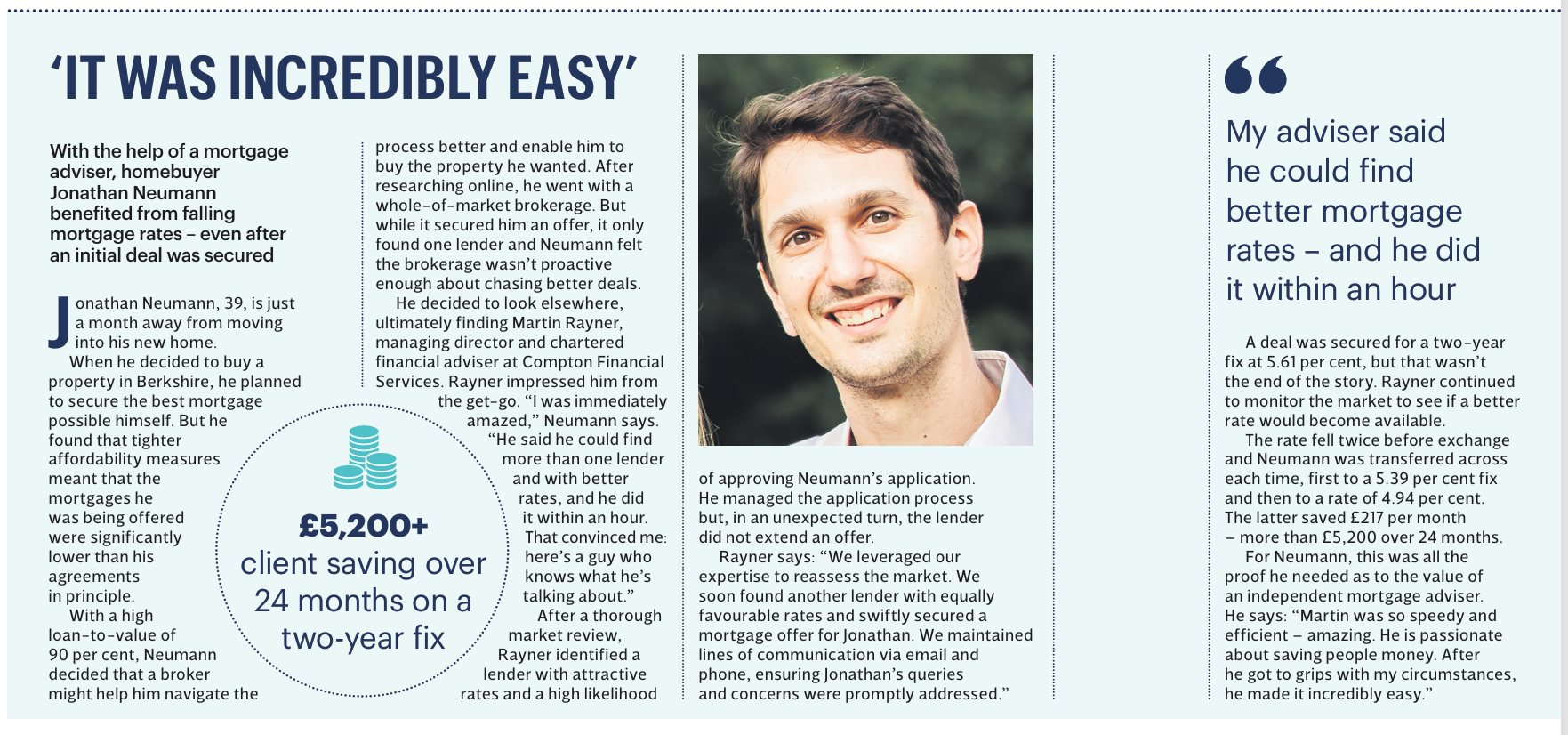
“We leveraged our expertise to reassess the market. We soon found another lender with equally favourable rates and swiftly secured a mortgage offer for Jonathan. We maintained lines of communication via email and phone, ensuring Jonathan’s queries and concerns were promptly addressed.”
— Martin Rayner, Chartered Financial Adviser and Mortgage Broker, Compton Financial Services
Insight: A client case study in VouchedFor’s Top Rated guide, published with The Times. It describes how Martin kept the client’s rate under review after the mortgage offer, moving them from 5.61% to 5.39% and then to 4.94% before exchange, saving more than £5,200 over a two-year fix.
Topic: Monitoring rates after a mortgage offer and switching to a lower rate before exchange
View the full pageThe Sunday Times
Strategically get the best mortgage rate when rates are falling


Insight: Compton Financial Services appeared in the Sunday Times Magazine’s ‘Best of Financial & Legal’ feature, explaining that a fixed-rate offer is not set in stone: if rates fall before your mortgage starts, you can often move to the lower rate, and if they rise, you keep the rate you secured.
Topic: Fixed-rate mortgage offers and switching to a lower rate before completion
View the full pageType your paragraph here